 Working satellites has certainly upped my activity level as far as ham radio is concerned. Between not getting out to do SOTA and the current sun spot activity making DX from my rather limited shack a hard task, ham radio was taking a beating.
My very first image – ever!
I will be the first to admit that VHF does not press my buttons. If I wanted to be a security guard with a “mall cop” radio, that would be different – but I am HF and SOTA and a bot around the edges!
Working a local repeater is about as much fun as well, its not fun. Nor is it exciting. Working a satellite is about the same thing – with one subtle difference – its moving at one hell-of-a-lick!
Tracking satellites and being available for the relevant *workable* passes is also a challenge, but at least it requires a bit of thought and planning – not like keying the local repeater.
My setup
My setup is probably about as basic as it comes – a 5W handheld with one of the cool AMSAT Yagi’s developed by ZSYI. You can imagine me walking all over my backyard pointing the yagi into the sky at odd angles, turning it around and keeping the squelch open. I often think my neighbours must think I am ET calling for an Uber!
 Now, getting images from the ISS – that sounds difficult and almost illegal. So of course I am interested!
Well it turns out it is neither difficult nor is it illegal. It is, however, still rather rewarding!
I downloaded the Robot36 app (from the google play store) – it is a free app and decodes SSTV (Slow Scan TV) signals. A simple, nice app that does what it claims to do!
I connected my handheld Baofeng UV-5R up to the station’s vertical antenna (on the roof) and tuned the Baofeng to 145.800MHz, FM. I placed the cell phone next to the radio and waited for a pass.
Ta-da! images

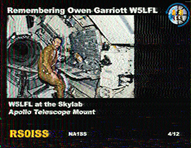
Remembering Owen Garriott – ISS images
From this very simple station I got the following images. QRM on the signal gives the “shaky/out of focus” look to parts of the image. As far as I can understand, the “green belts” are lack of signal into the decoder (rather than distorted signal).
Another part of the puzzle – with my station in particular – is the fact that I used a single vertical antenna (rather than a yagi pointed at the satellite) so the signals on the horizon are better (into the vertical) than when the ISS is directly overhead. Imagine computer controlled yagis tracking the ISS in real time! Ok, it is a reality for some people, but not me in my shack – I have to do it the hard way 😉
Here are a few more images:


0 Comments
1 Pingback