Those who know me, know I am not keen on VHF, nor on repeaters – and are surprised to find my latest hobby is working satellites. It’s not quite the same as working a stationary terrestrial repeater – not when the repeater is traveling at 11 – 27 thousand kilometers per hour!
So, what can you do working satellites?
There are a variety of satellites with ham radio transponders/repeaters on board. These range from download only (usually telemetry or CW beacons) to cross-band repeaters on FM and SSB.
Working an FM satellite is a piece of cake! Get a handheld – a UV-5R or equivalent is more than adequate. Set the radio to the receive frequency, the tx to the tx frequency and go. The standard “rubber duck” antenna on the handheld is all you need for a high pass. Working the passes closer to teh horizon you need a yagi.

The AMSAT yagi I love so much!
The AMSAT yagi as available on the AMSAT SA website is a good place to start. That and a fitting onto the HT of your choice and you have a fully operational “Ground station”.
Antennas and polarization: While you must understand the satellite is travelling at one hell of a rate of knots, it is also turning. Consider, also, the path a satellite might take and how a standard vertical antenna will work on receive and transmit. When the satellite is directly overhead of a vertical antenna, you will get no signal. When the satellite is on the horizon (further away utilizing a lower radiation angle) the vertical will be better. A yagi, however, wins hands down in both cases.
There are plenty of youtube tutorials about working satellites and they will all tell you antenna orientation is important. And it is, but get out and play – you will soon figure it out.
Apart from working other hams through a satellite, downloading telemetry from a satellite, you might also get a chance to work an astronaut on-board the ISS. This is indeed a rare occurrence, although schools can schedule a QSO with the ISS, regular radio hams like Andre, ZS2BK need to be in the right place at the right time to get the contact. Andre, ZS2BK had a chat with Richard on the ISS and managed to record the QSO – one of which he is very proud!
What about getting images from the ISS? Every so often the ISS transmits images on SSTV – usually now in mode PD120. At the time of writing this post, the ISS is transmitting a range of images in remembrance of astronaut and engineer Owen Garriott. Download an app to decode SSTV – I use Robot36 on android and MMSSTV on Windows. Set the mode to PD120 and place it within “earshot” of a radio receiving on 145.800MHz while the ISS crosses overhead.
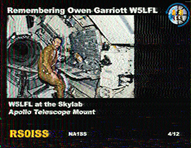
The first image I received from the ISS
The PD120 mode takes 2 min to send an image and is then followed by a 2 min break, so you would think you would get 5 images per 10 minute pass, but it is not quite that simple. You should get between 3 and 5 images – along with partial images depending on where in the tx cycle the satellite is at your AOS/LOS and so on.
For more on images from the ISS, check out my post here. What about a SOTA activation by satellite ? What about RADAR? The possibilities are almost endless.
I will leave you with a single thought that blows my mind.: There are people (Andre, ZS2ACP for example) who have worked a DXCC via satellites!


